

Teaching AI to Remember
From Stateless Bots to Knowledge-Graph-Powered Agents
Imagine meeting the world’s most brilliant expert, but every time you take a brief pause in conversation, they completely forget who you are, what you were discussing, and every single thing you told them five minutes ago.
That is precisely how Large Language Models operate out of the box.
To build intelligent AI agents capable of long-term assistance, personalized workflows, and deep reasoning, we must give them a human-like memory. This is the story of how AI moves from zero-memory token processing to long-term memory systems and Knowledge Graphs.
Key Technical Concepts Simplified
Before diving into the journey, here is a simple cheat sheet of technical terms used throughout this guide:
LLM (Large Language Model): A massive pattern-matching engine that predicts the next word based exclusively on what it is reading right now.
Statelessness: A system property where every request starts completely fresh with zero memory of past interactions.
Context Window: A temporary digital whiteboard where the AI reads current instructions and recent chat logs before generating a response.
Relational Database (SQL DB): An Excel-like storage mechanism that keeps data strictly organized in fixed tables with rows and columns.
NoSQL Database: A flexible storage mechanism that saves data as freeform documents or key-value pairs without requiring rigid structures.
Vector Database (Vector DB): A digital filing cabinet that stores information based on mathematical meaning rather than exact keyword matches.
Knowledge Graph (Graph DB): A spiderweb-like database that connects entities using explicit relationships, mimicking how human brains cross-reference thoughts.
Mem0: A specialized memory architecture for AI apps that automatically extracts, updates, and retrieves long-term memories.
GDPR & CPRA: Global data privacy regulations that legally mandate a user's right to view their stored data and delete it whenever they want.
The Starting Point: Why LLMs Are Stateless
At its core, a Large Language Model is simply a token processor. It receives an array of input tokens—represented mathematically as sequence positions \([-N:0]\), \((n-1)\), $(n)$—processes them through transformer neural layers, and outputs the next sequence of tokens ("crunching tokens").

Once the generation process finishes, the model shuts down its active execution context. It does not retain state in internal weights between separate API calls.
Because LLMs are completely stateless, every session begins as a blank slate. If you tell an LLM your name in turn 1, it will not know your name in turn 2 unless your name is explicitly sent again in the input payload.
The Naive Solution: The Context Window Hack
When developers realized LLMs forget everything between turns, the initial workaround was straightforward: pass the entire conversation history back into the context window on every single turn.
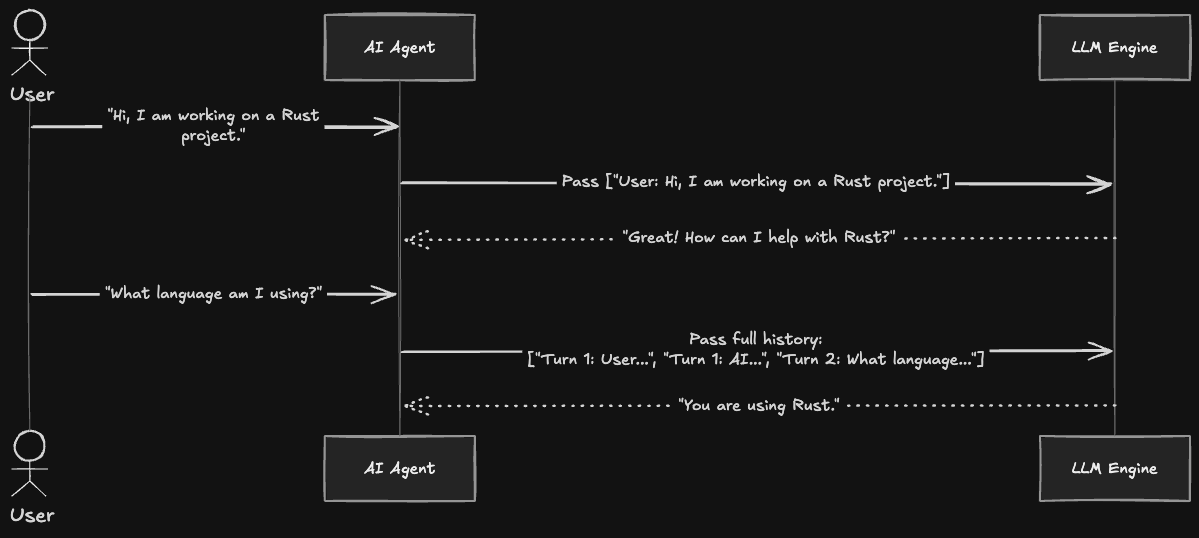
Why Context Window Repeated Stacking Fails
While this workaround creates the illusion of memory, it quickly breaks down in real-world applications due to key architectural limits:
Token Crunches & Costs: Every extra message increases input token usage exponentially, leading to higher API bills.
Context Degradation: As the prompt grows excessively long, prompt ingestion performance drops, leading to issues like "lost in the middle" retrieval failures.
Window Size Limits: Even with million-token context windows, context is temporary. Once the window overflows or a new session starts, history resets.
A context window is an active temporary workspace—it is context, not memory.
Introducing True AI Memory: Short-Term vs Long-Term
To move past basic context stuffing, AI architectures split state management into two distinct layers: Short-Term Memory and Long-Term Memory.
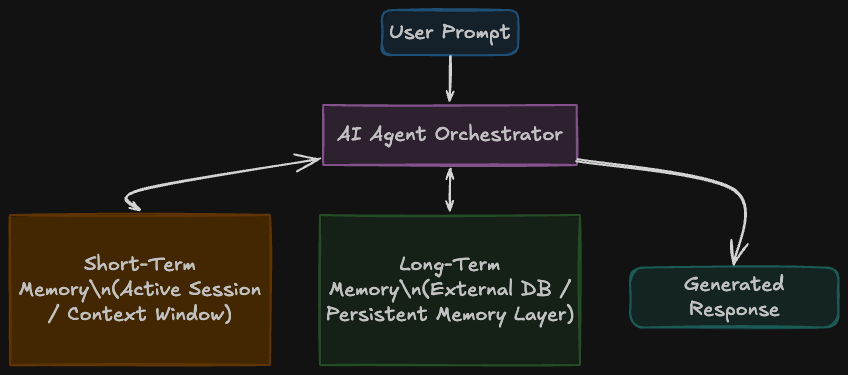
Here is how the two compare:
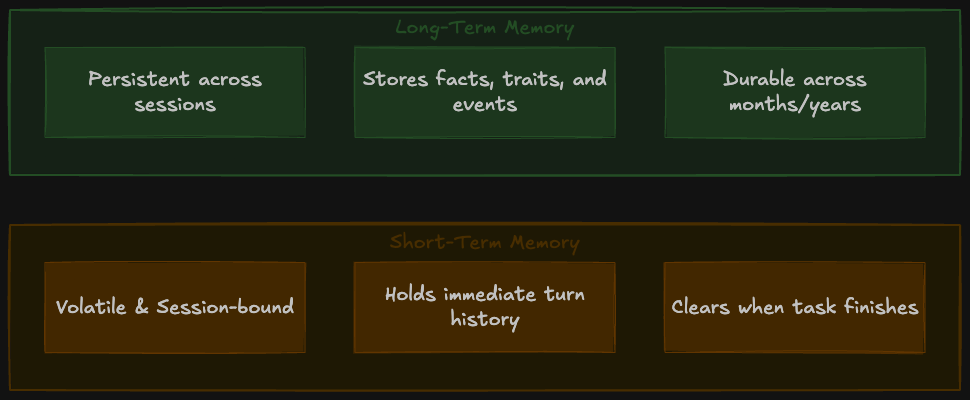
Structuring Long-Term Memory: Episodic vs Semantic
Human brains do not remember every single word ever spoken; instead, they categorize past experiences into specific memory types. Intelligent AI systems mirror this structure by splitting long-term memory into Episodic and Semantic storage.
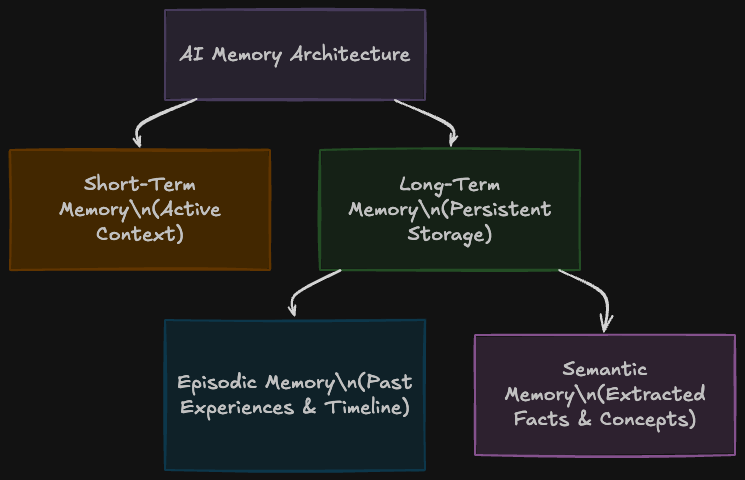
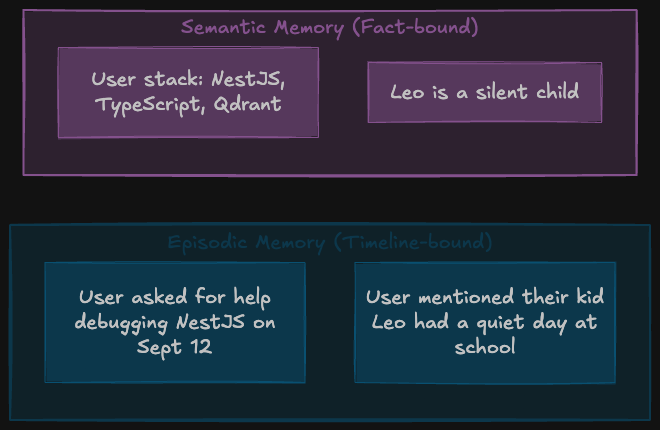
1. Episodic Memory (Experiences)
Episodic memory preserves specific past events, interactions, and temporal logs as they happened.
- Example: "On Tuesday, the user ran into a build error while configuring an STM32 microcontroller and felt frustrated."
2. Semantic Memory (Facts & Knowledge)
Semantic memory strips away the background timeline to store condensed, objective facts, preferences, and entity knowledge.
- Example: "The user prefers low-level programming in Rust, works in Bangalore, and uses Arch Linux."
The Memory Lifecycle: Write, Update, Retrieve, and Forget
Memory cannot simply be an ever-growing list of text files. If memories are never updated or pruned, old information will conflict with new information. Efficient AI agents manage memory through four core operations: Write, Update, Retrieve, and Forget.
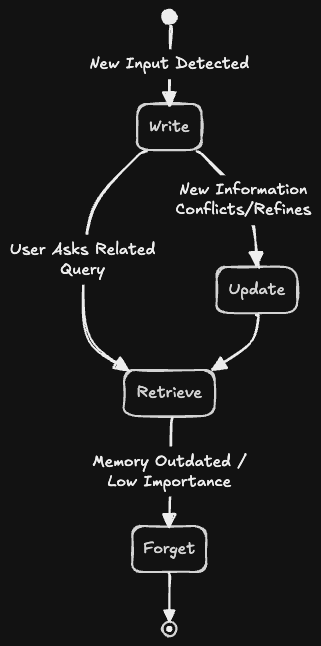
Write: The agent scans incoming interactions, extracts important facts or episodic events, and writes them into long-term storage.
Update: When new data alters an existing memory, the system updates the record rather than duplicating it. (Example: Updating "User lives in Mumbai" to "User lives in Bangalore").
Retrieve: When a user sends a prompt, the agent searches long-term storage, pulls out only relevant memories, and inserts them into the context window.
Forget: Information that becomes obsolete, contradicted, or stale is deleted or decayed over time to keep memory retrieval fast and accurate.
Implementing Memory Layers with Mem0
To automate the memory lifecycle, developers use specialized memory frameworks like Mem0.
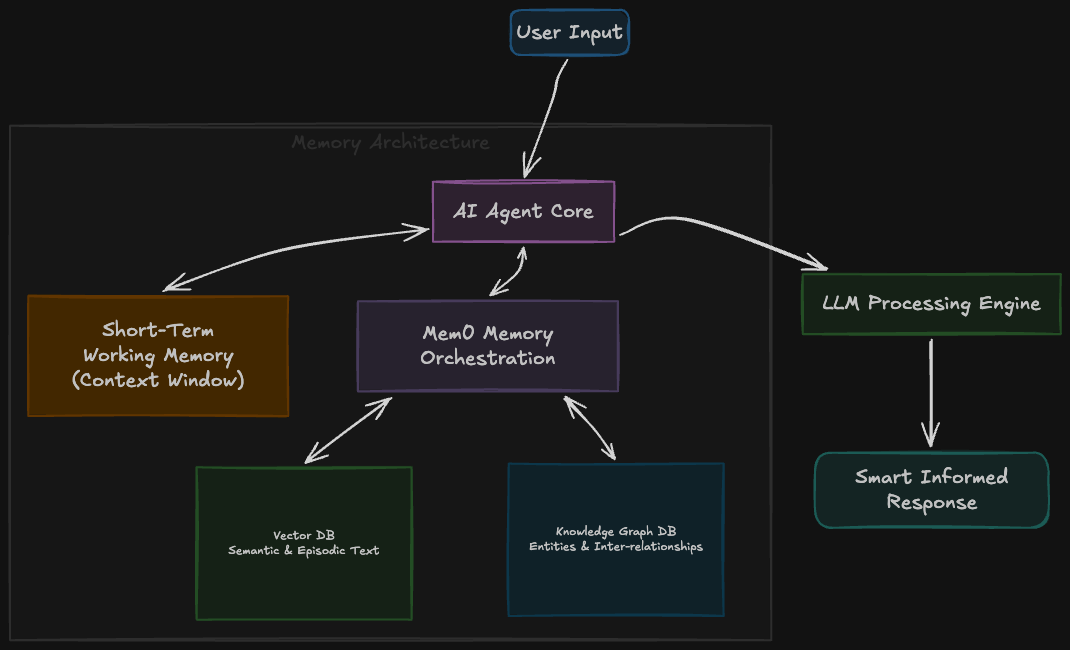
Rather than requiring manual database queries, Mem0 sits between the user and the LLM. It automatically converts unstructured dialogue into structured memory updates using an underlying vector database or document store.
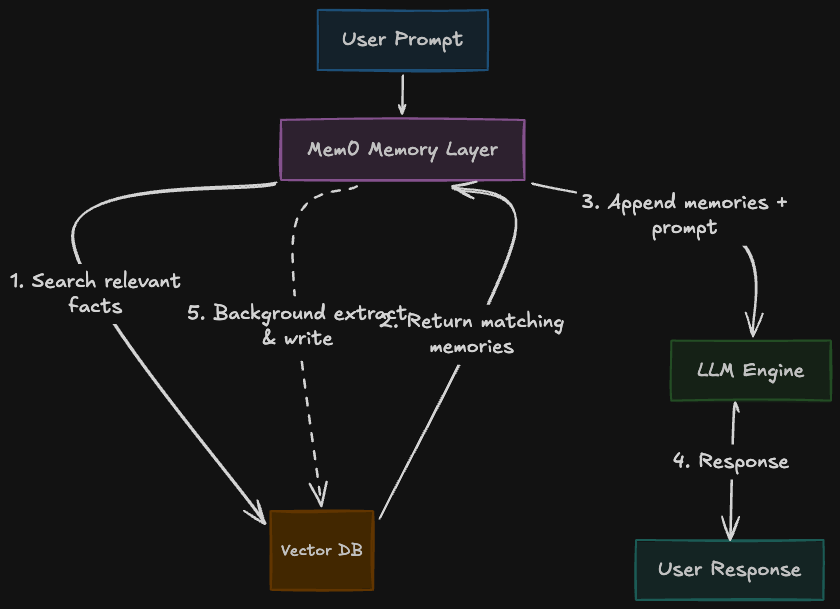
- How Mem0 Works: When a user speaks, Mem0 performs semantic search using vector embeddings to retrieve relevant past facts. In the background, it evaluates whether the new message contains novel facts, automatically triggering Write, Update, or Forget operations.
The Next Arised Problem: Unstructured Vector Search Falls Short
While vector databases and semantic memory layers excel at finding text with similar context, they struggle with structured entity relationships.
The Case of Leo and Max
To see where pure vector search breaks down, consider two kids:
Leo: Kid X, who is naturally quiet and silent.
Max: Kid Y, who is energetic and a menace.
Statement 1: "Leo is a silent kid."
Statement 2: "Max is a total menace kid."
If you later ask the agent: "Do you remember any silent kid, and how are they connected to the menace?"
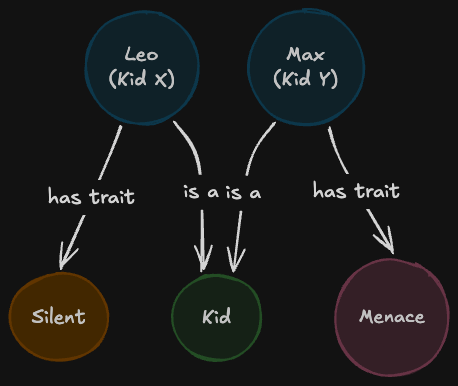
A standard vector similarity search might match the word "silent" to Leo and "menace" to Max separately. However, it doesn't naturally understand multi-hop graph paths like: Leo \(\rightarrow\) is a \(\rightarrow\) Kid \(\leftarrow\) is a \(\leftarrow\) Max. It treats these stored facts as isolated chunks rather than a linked network.
The Solution: Knowledge Graphs for Interconnected Memory
To remember connections the way human brains do, we use a Knowledge Graph.
A Knowledge Graph maps nodes (Entities like Leo, Max, Silent, Menace, Kid) connected by labeled edges (Relationships like IS_A or HAS_TRAIT).
How Knowledge Graphs Resolve Complex Memory Queries
When an agent accesses a Knowledge Graph, memory retrieval shifts from simple string matching to graph traversal:
Query: "Who is the silent kid?"
Traverse Path: Find node
Silent\(\rightarrow\) trace incoming edgehas trait\(\rightarrow\) arrive at entityLeo.Query: "Which other kids exist in the system and what are their traits?"
Traverse Path:
Leo\(\rightarrow\)is a\(\rightarrow\)Kid\(\leftarrow\)is a\(\leftarrow\)Max\(\rightarrow\)has trait\(\rightarrow\)Menace.
By combining relational structures into graph nodes, AI agents can recall deep associations—just like how you remember details about your friends, family, and shared history.
The Complete Agentic Memory Architecture
By integrating LLMs, context management, Mem0, and Knowledge Graphs, we get a fully context-aware, long-term memory system for AI agents.
Ethics and Privacy: What Should an AI Remember?
As we build persistent AI memory systems, a vital architectural and ethical question arises: Should an AI remember everything?
Storing user interactions indefinitely creates serious privacy and safety challenges.
Cloud Storage vs. Local Privacy
Cloud AI Services: Passing sensitive private information to big corporate cloud APIs raises trust concerns. If users are hesitant to text private details over messaging apps, they will be equally hesitant to store complete personal memory logs on external servers.
Local AI ("Go Hard" locally): For maximum privacy, sensitive memory layers can be hosted locally on-device. This ensures personal context never leaves the user's hardware.
Governance Rules for Building AI Memory Systems
If you are building a SaaS product or AI agent with persistent memory, you must follow strict data protection standards:
Explicit Consent: Clearly distinguish between temporary conversation context and saved long-term memories.
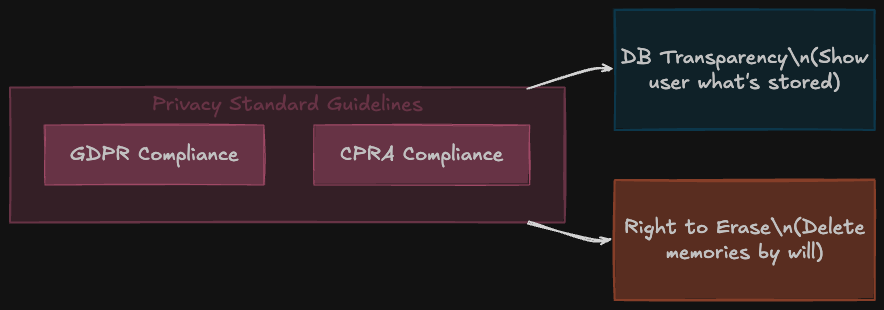
DB Transparency: Show users an intuitive dashboard of everything stored in their memory layer (both Vector DB entries and Knowledge Graph nodes).
Delete by Will: Comply with regulations like GDPR and CPRA by providing a single-click mechanism for users to clear, update, or permanently erase their stored data.
Filter Sensitive Data: Automatically redact passwords, government IDs, and private authentication keys before writing state to long-term memory.
Conclusion
Moving beyond stateless token processing opens up new possibilities for AI software. By combining Short-Term Context, Semantic Mem0 layers, and Knowledge Graphs, we can transform forgetful chatbots into context-aware digital assistants—all while keeping privacy, user consent, and security at the center of the system.


